



This is our biggest drop yet. No student gets better at reading by accident. It happens rep by rep: one passage, one quiz, one small correction at a time. That’s the idea we keep coming back to, and it’s the thinking behind everything we’ve built for this school year: practice makes progress.
And that’s not a slogan. When we looked at a full year of classrooms, the ones that kept a steady practice rhythm grew up to 7.6× faster than the ones that didn’t. Everything below is built to make that rhythm easier to start, easier to keep, and easier to see. Here’s what’s new.
Finally, No More Ads!
What’s new
Starting this year, ReadTheory is completely ad-free for every free user. No interruptions, just reading.
Why this matters
When we started ReadTheory, the promise was simple: every student deserves to become a stronger reader, and that shouldn’t cost anything. So we made it free, and ads kept the lights on while the door stayed open to everyone.
But you told us the ads were pulling students away from the very thing we built ReadTheory to strengthen. For some of you, they weren’t just a distraction, they were a dealbreaker. School and district policies meant you couldn’t bring ReadTheory into your classroom at all.
That didn’t sit right with us. So we removed them. Our oldest promise still holds: the door stays open to everyone. If you’re not signed up yet you can sign up for free here.
Know every student’s level in 14 minutes
What’s new
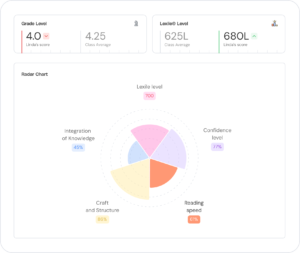
Built-in Beginning-of-Year, Middle-of-Year, and End-of-Year benchmarks are now part of ReadTheory. No extra tools, no separate login, no new vendor or budget line-item to manage.
Why this matters
In about 14 minutes, you’ll know exactly what a student can do, what Lexile Level they are, and what to teach next. No long testing days, no waiting for results to come back. Clear insights in minutes.
A bigger, better printable library
What’s new
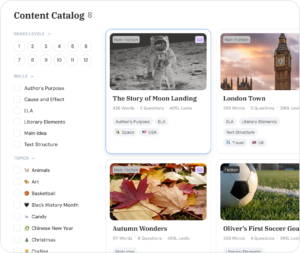
ReadTheory’s printable library keeps growing: fiction and nonfiction, across every topic (yes, even that one), written by PhDs and teachers. Search by curriculum standard, topic, grade level, or skill and find what you need in seconds. And soon, teachers will be able to create and level their own content right on the platform. We’re talking passages, quizzes, worksheets, graphic organizers… you name it.
Why this matters
Good reading practice needs good material behind it. Real subject-matter experts and real teachers write and/ or approve this content, so what your students are practicing with holds up. Next, this fall we’re moving our AI passage builder into the platform so teachers can build and level their own content in ReadTheory and the library grows with the classroom, not just the catalog.
One dashboard for your whole school or district
What’s new
School and district leaders now get a single dashboard for everything: no spreadsheets, no digging through separate reports to see how a school or grade is doing.
Why this matters
You can’t act on progress you can’t see. One dashboard means principals and district leaders can check in on every classroom in one place, and spend that time on decisions instead of data analysis paralysis.
Student motivation engine
What’s new
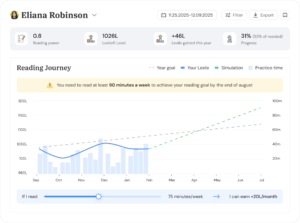
Over the past year, we’ve been studying what actually builds reading growth for students. Our theory (pun intended) comes down to four essential ingredients:
- Ownership, students setting their own goals.
- Accountability, tracking and refining their own progress.
- Collaboration, partnering with their teacher.
- And Recognition, feeling seen and valued for the work they put in.
Why this matters
A student practices consistently when the practice feels like theirs, not just an assignment handed to them. These four pillars are the reason a student opens ReadTheory on day 40 the same way they did on day one.
Coming this fall: a reimagined student experience built around this engine. Students will be able to set their own goals, track their growth, and celebrate their progress every step of the way. It’s still in development, but we wanted to share where we’re headed because we believe in building ReadTheory alongside the educators who use it every day and have been on this journey with us.
More ways to collaborate, school-wide
What’s new
Teachers and admins can now share classes with each other, so a roster, a lesson, a report, or a resource doesn’t have to live with just one person.
Why this matters
Reading progress isn’t a solo effort. These tools make it easier for school and district communities to work together and learn from each other.
A leveling system built to move every student forward
What’s new
ReadTheory’s leveling engine has gotten even smarter. It adjusts to give each student work that’s just hard enough to push them forward, and never so hard it stalls them out.
Why this matters
Progress stops when practice is either too easy or too hard. A smarter leveling system keeps every student in that sweet spot: challenged, not stuck, so the practice they’re doing actually turns into growth. No more yo-yoing!
A quick note on our new look
What’s new
You may have noticed ReadTheory’s logo looks a little different. The new mark is fresh enough to signal where we’re headed next, but it’s built on everything that got us here.
Why this matters
Look at the four bars next to our name. Each one stands for a piece of what actually motivates a student to read: Ownership, Accountability, Collaboration, and Recognition, the same four pillars I mentioned going into the new student dashboard launching this fall.
The colors stay varied on purpose. That’s not random. It’s a classroom. It’s the millions of students around the world working on ReadTheory right now, all different, all reading.
Look again, and the four bars also read like a bookend, literally holding the name up. That’s fitting as a bookend’s only job is to keep something from toppling over, and that’s exactly what these four things do together, not just for one student’s motivation, but for the schools and teachers leaning on ReadTheory every day. Take away ownership, accountability, collaboration, or recognition, and things get shakier. The four bars aren’t decoration. They’re structural. They’re what’s holding everything up, for students and for the schools behind them.
We wanted our name to carry that same idea, not just describe it. Real progress isn’t one thing. It’s a lot of things (and people) all working together every time a student sits down to practice.

Practice makes progress
None of this works without the people using it every day. Tell us what’s missing in your classroom. Tell us what it would take to serve every reader in your building. Email us (a real human actually does read each one, her name is Caitlin.) support@readtheory.org The best ideas we’ve ever shipped came from teachers, not from us. Here’s to a year of steady practice and real progress, for every student, in every classroom.
